

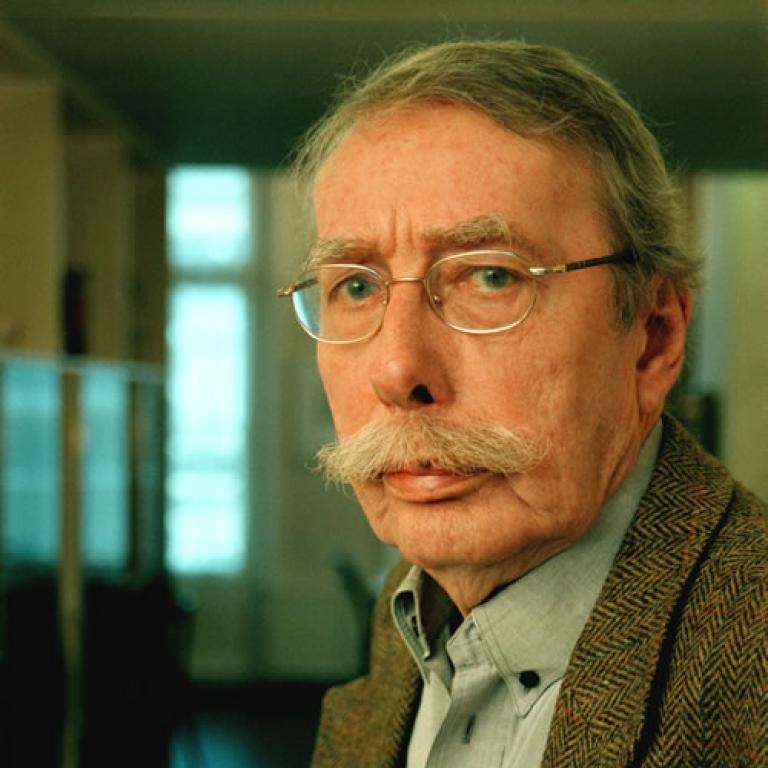
Gerrit Kouwenaar (1923–2014) was a towering figure in modern Dutch poetry. In the words of a 2009 prize jury, Kouwenaar ‘has long been generally regarded as our greatest (living) poet’. His work spans six decades and 25 published collections of poetry. These gained him the Low Countries’ top literary awards, and influenced generations of younger poets.
Kouwenaar was born and died in Amsterdam, though his second home in southern France forms a backdrop to many of his poems. He found his voice as one of the ‘Fifties’ group of poets and artists who sought to revive mid-century Dutch culture with a new experimentalism. A key motif throughout his work – the relationship between the word and the world – has its origins here. But over the decades, other themes came to dominate. Rootedness in house, garden and landscape. The sensual here-and-now of food, drink and friendship. And an ever more compelling exploration of time, transience and, ultimately, bereavement – against which he pits the poetic act and the fact of his own survival.
The power of Kouwenaar’s poetic voice, however, lies in his mastery of language. Sounds and etymologies echo and glance off each other – rhyming and assonating, weaving in wordplay and ambiguity, and releasing the different layers of meaning in idioms.
Kouwenaar’s poems have featured in many English-language anthologies and journals, and in a translation of his 2002 collection totally white room which is out of print. Francis R. Jones’s edition, about time: selected poems (Bloodaxe Books, 2027), is the first book-length selection of this European master poet’s work in English. Michele Hutchison’s translation of his classic wartime coming-of-age debut novel, Fall, Bomb, Fall (1950) was published by Pushkin Press in 2025.