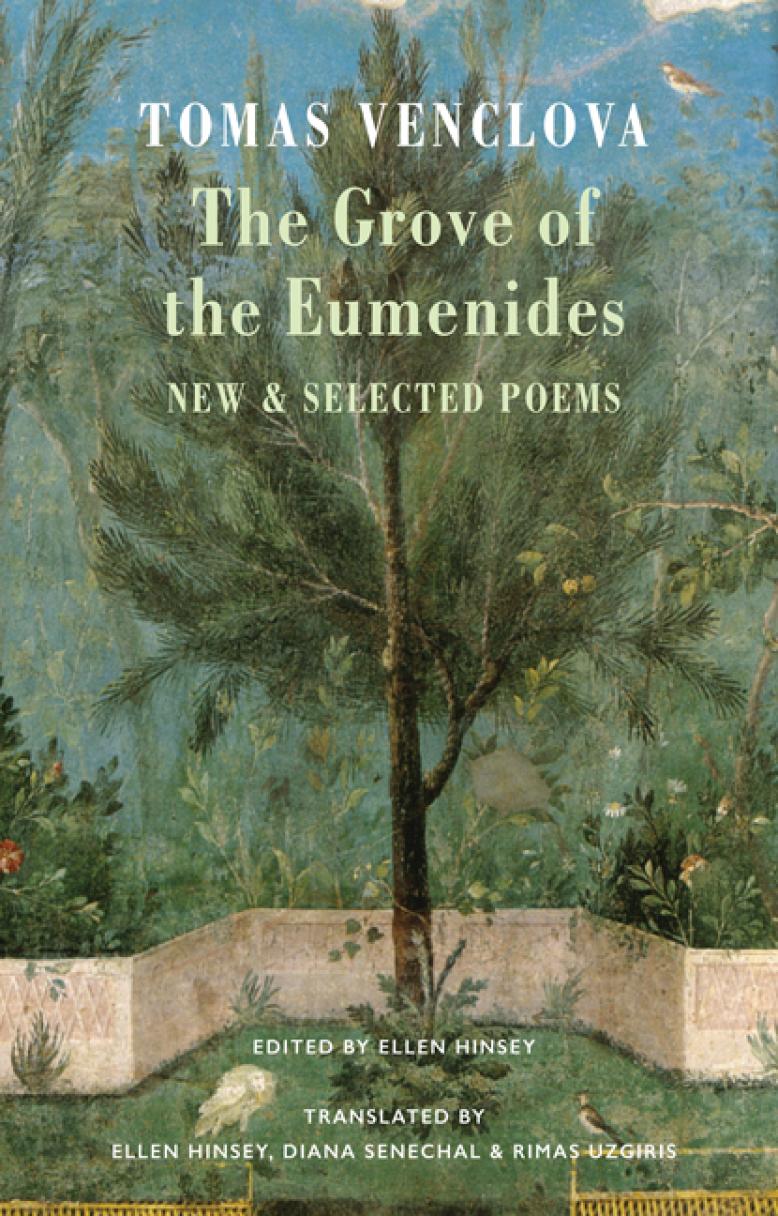
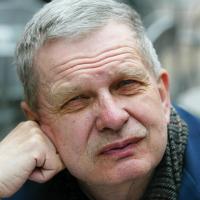
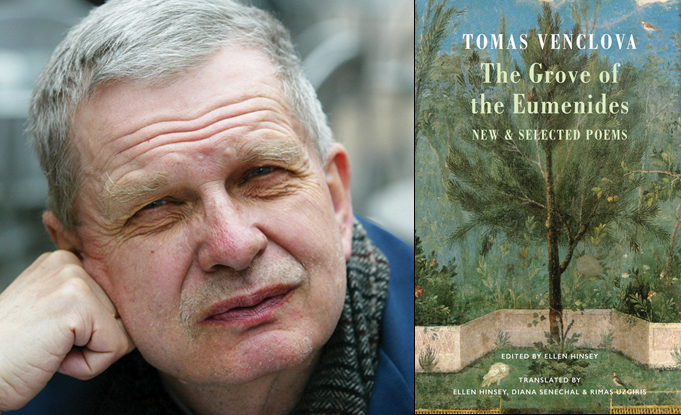
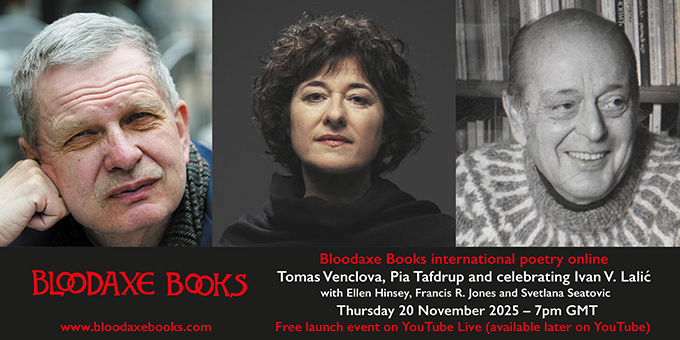
Tomas Venclova: profile & reviews for The Grove of the Eumenides
Poetry Foundation USA profile of Lithuanian poet Tomas Venclova; reviews online in Asymptote & The Lake; video of his discussion event in Cambridge on 27 Feb 2026.
Tomas Venclova's joint online launch for The Grove of the Eumenides is on YouTube, as is his discussion at Cambridge University's Centre for Geopolitics. Profile...
Whatever else, speak. Verse hardly holds what is pressed
Over time into the hardening clay of consciousness.
There, we find contrasts of colours and fine detail,
The ocean’s gleam, shame, wonder, and our travail.
Maybe after death. But the plane rolls down the runway.
Maybe when you won’t exist. But a sentence has no fate.
Over the horizon’s line, by the switchback – a medley
Of roofs. The citadel casts its shadow by Gurdić Gate.
Greet the scorched grasses, whose dry clumps lock up
The stretch of bay where nameless towns of stone
Age and decay. Thunderstorms slip along the strand
On the other side of the well-burnished slope.
Clouds. An untamed motorboat stirs the current alone
And from bay bottom raises Mediterranean sand.
Now, in the darkening mirror, you don’t meet you.
A lamp, a keyboard, a dictionary. That much came true.
On the windward side of storms, at Europe’s deaf edge,
Where you’ve been taken by fate or divine caprice,
You will lodge in darkness, as others have found a place
Beyond horizon’s brushstroke or the switchback’s ledge.
The keyboard flickers, a presence hovers that you but feel.
The mirror fades. Age enfetters the fatigued body alive.
You can’t begin from the start, no matter how you strive.
Whatever else, now speak. There is nothing more real.
[tr. Rimas Užgiris]
*
Azovstal
Hail to you, forgotten Goddess of History!
With your rocket-shell retinue, slaughtered soldiery,
We recognise you – emerging – that day of fear,
When caterpillar treads and helicopters cross the border.
Then we grow accustomed to your rule. At first:
A high-rise’s ruptured chest, trees ablaze on the coast,
Blasted train junctions, the endless steppes’ theatre
Where, mired in black earth, Mazepa was cursed by Peter.
For Death is still young. She needs agility, time –
To train, master her craft – slowly takes aim,
Flails for a while: the body greeted by shrapnel
Only after the fifth try – after, a dead lull falls.
A drone traces an invisible path in the air.
The twenty-year-old guard slowly leads an elder
Behind a fence’s shelter – what matter he’s a civilian –
For both, the last few metres will only lengthen.
A pea coat’s owner abandons one site of ruin –
Occupies another. A satellite docked in the heavens
Impassively looks on. Cannon blast a nitrogen cistern:
Ten blocks have been taken – gloria nostra aeterna.
How distant the harbours and train stations of salvation!
Facing the checkpoint: friend or foe? It’s unknown –
Will they shoot or let you go – chickens left by gates
For looters, goats loose in yards – turn the gaze
To the map with unmarked Trostyanka, Merefa, Irpin –
With their torn-off roofs thrusting up through nettles,
And caught in the throat: the stench of those no longer,
While children learn to say ‘traitor’, ‘rifle’, ‘hunger’.
A bullet, not a seagull, incises the low tide’s line,
Beyond a broken window, a mirror reflects clear skies –
Descendants born in shelters will observe it with fear,
For not God’s kingdom, but a sky of nuclear threat is near.
Clotted blood stains. The bass and alto of explosions.
For every Thermopylae there will be an Ephialtes.
Bid them farewell – for honour or shame, you don’t know:
The path’s cut off: in the end, the Medes will break through.
So then, Goddess of History, war remains war.
In a hostile city: a sunshine-struck boulevard.
A student under a linden grinds a cigarette into sand,
Repeats the old line: ‘How sweet it is to hate one’s fatherland’.
And the soldier – his comrades won’t recall his patronym –
Subsists on stale air in the underground labyrinth,
Yet when his words cease, stone and concrete will repeat
The defiant riposte Cambronne hurled at his attackers.
[tr. Ellen Hinsey / Rimas Užgiris]
*
The Grove of the Eumenides
Now touch the wrinkled mallow’s bud,
then climb the hill, look back, up north.
Cafés have closed, and wheels don’t roll
along the city streets. Some homeless dogs
still snore where acacias shade syringes. Years
have passed since your last visit. Grapes,
bay leaves, and mostly mugwort. Pour
some honey for the mute sisters on the hill.
The weight of June makes cracks in clay.
You use the pupils of others’ eyes to see
the humid air that quivers above the sea,
where scattered rays like Doric columns cleave
the sky and cradle a crumbling day.
A fortress hides among the roofs in mist.
Now meet your fate not in Athena’s place,
nor Thebes’, but in what is left of Colonus.
The crowded suburb rests, silent under sun.
The gods have changed, Ananke aged.
A ditch of thistles holds a piece of peristyle,
which may be more Idea now than porch.
A runner panted here then met his fate.
The Lord Almighty plays with us while we
grow blind and learn you can’t deny your sin
as skies heat up and bodies turn to ice.
The patient Eumenidean spring has dried.
What once were Erinyes now scorn all discord.
A gesture from them can silence cypresses,
make planets cease to spin in distant heavens,
and sails hang limp on their black masts.
The osprey now is all that moves:
it scours the sea in vain for prey,
its fall like that of Icarus ignored.
You are behind the times already. It’s late.
The wise men said it’s best to not be born,
and if you were, then not for long. Cement
now covers sacred slopes. Instead of Theseus,
an ant is left to lead, and inch by inch
it navigates the ruin, wrecking rhythm on its way.
Will lightning strike, or storm wipe us away,
or will the earth split open? The Judge should know –
But what if He does not? This place now sleeps
and sinks into a smog as into steamy sheets –
into the bitter scent of mint, or drought,
or nothing. Olive leaves blush and burn.
An ancient alphabet grows black here, etched
on windowpanes where roofs ascend the slope.
The quickly broken echo of a sigh
now deepens in summer’s heavy silence.
[tr. Rimas Užgiris]
The Way to Planty Park, Kraków
The jasmine blooms between tramway stops.
You could have lived and died here, but decided to return to your own baroque, your knotted alleyways, dilapidated courtyards, the duchy along two rivers, and this you probably won’t regret.
So then, old age. The bones grow heavy, the senses slowly close their doors, and dimming eyes no longer see the pinnacles in the sky. A long-legged, raven-haired beauty boards the tram – the type you always liked to see. You hear her every utterance, but can’t catch the sense of a single phrase.
Colours and scents are out of joint. You see enough to recognise the doors of Austrian Art Nouveau as they slide by. Then the theatre, the crossing of tram tracks, and a straight road until the rectangular square whose concrete is interrupted by freshly planted wraith-like linden trees.
It’s time to say goodbye to cathedrals and paintings, as well as to maps and atlases – things you preferred to most books. Goodbye to coffee steam and the suppleness of a beloved cheek.
To tell the truth, you were lucky. You never knew a prison bed or crushing poverty. You were not destroyed by alcohol, though you lived with it, as everyone in your generation did. You avoided spending eight hours a day filling out forms. You found delight in fruit trees and the female body, though those fruit trees grow no more, and the shawls and hats of your girlfriends have long since frayed. You saw what you wanted to see, but didn’t believe you would see. You did a thing or two, but most importantly tried to avoid actions which would bring you shame until death, or even after. You almost succeeded.
You hurt those who loved you, and they forgave you, though you didn’t always forgive yourself.
You understood that it’s wrong to march in step with the crowd – even when, or especially when, the hymn they sing is easily understood and your own.
Your poems will be read by one or two people at night, but thank God, never recited at a government event.
You walked on the edge of the abyss – specialists gave it the Latin name, id – but you were able to keep it at bay. The alarm clock helped, stirring you to work each morning, but really it was the declensions and prosody of words.
As Solon warned, it can all fall apart. Call no man happy until he’s lived through all his appointed days. And there are thousands of those days, not a single one like another.
But the angel that watched over you since childhood, on the slopes of the Nemunas and in suburban alleys under silver spruce, will probably still be with you, as long as you know how to ask.
Everything gets bigger towards the end – distances, jasmine bouquets, and cobblestones. Only wonder has no dimensions, wonder that there is a world at all, and that it remains after you are gone.
[tr. Rimas Užgiris]
Contents List
15 Ellen Hinsey: Tomas Venclova: Poetry of Witness and the Return of History
I
25 On Both Sides of Alnas Lake
27 To Master Radovan
29 Dictator
31 The Process of Beatification
33 Before the Fort
34 Azovstal
36 Flight
39 The Grove of the Eumenides
II
43 South of the Prospect
45 Chinese Impressions
54 Landscape with Polyphemus
55 Three Imperfect Sonnets
57 ‘The Stream of Smoke Dissolved in Yesterday’s Air’
58 Prehistory
60 Cavalryman near Seinai
61 Beyond St Anne’s and the Bernardines
63 Extra Urbem
66 Caligula at the Gates
III
69 August Elegy
71 Notes on Xenophon
74 Death of the Argonaut
76 ‘Tell me, what did you love? One city you left behind’
77 Mother of the Living
79 ‘It’s not instantly clear why it comes up so rich’
81 From the Future
82 Kotor Sun
83 Eos
IV
87 Hamden, Connecticut
89 Hurricane
91 Three O’Clock at Night on the Sea
94 Syllabic Stanzas
96 The Moss of Ammassalik
98 ‘Leaving the subway with a pack on my back’
100 The Way to Planty Park, Kraków
102 Variation on the Theme of Awakening
104 Delft
105 To My Daughter
106 ‘Let the time you no longer remember’