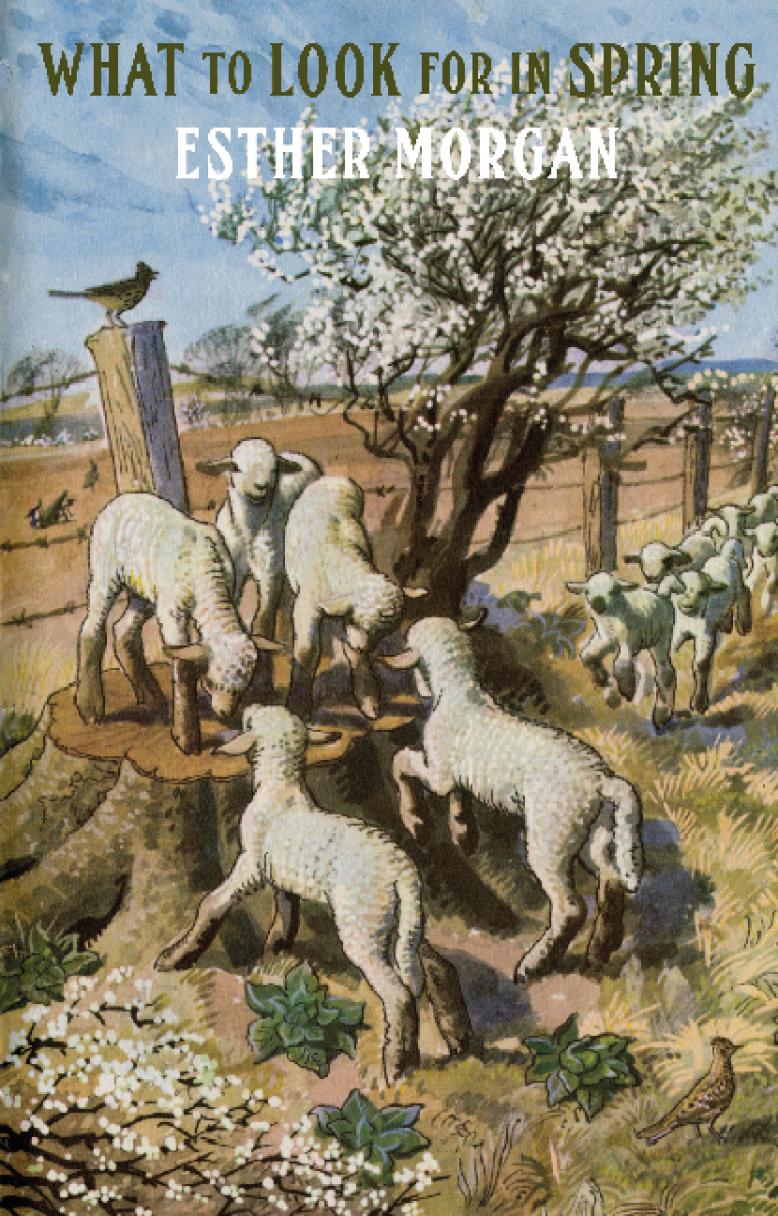
Esther Morgan’s What to Look for in Spring asks what ‘home’ might come to mean in a rapidly warming world where the ‘handful of birds and plants we know by name’ are already starting to disappear.
The once commonplace sights and sounds of an English spring evoke the ghosts of Wordsworth, Hardy, Edward Thomas and others in poems which also probe our nostalgia for a vision of England that ignores the class structures on which it was based. In one startling sequence the birds, trees and flowers of Browning’s ‘Home Thoughts from Abroad’ become prophets bearing witness against their fate.
Other sources of inspiration include a set of vintage Ladybird books about the seasons and the Biblical story of Exodus as well as more personal reflections on the fragility of home seen through the lens of motherhood. Throughout, Morgan fuses tenderness and terror in poems which examine how climate change threatens to make migrants and exiles of us all.
Set against this sense of rupture are two sequences based on the art of John Crome (1768-1821) and John Constable (1776-1837). Crome’s honouring of the overlooked in his Norfolk landscapes prompts an approach which offers a quietly radical alternative to click-bait and outrage. Constable’s famous sky studies by contrast are the springboard for poems as wake-up calls to the spirit – keen as an easterly wind or a dash of cold water to the face.
In her fifth collection – her most ambitious and formally inventive to date – Esther Morgan extends her imaginative territory while retaining her lyric gifts to make home and its loss a tangible reality – piercing as the screams of swifts ‘like a fairground ride/on the other side of living’.
‘Whenever we think of home
we come to this:
the handful of birds and plants we know by name.’
from ‘Ports’ by John Burnside
Praise for Esther Morgan's poetry
'Grace, Esther Morgan's third collection, is an extraordinary, radiant book. Its poetry makes quietly insistent demands uppon the reader: "In the stillness, everything becomes itself."... The afterglow of Esther Morgan's luminous work is not certainty, but questions. Can imagination transform, or simply recognise, what is there? Do these poems come by grace of Muse or angel?’ – Alison Brackenbury, Poetry London
‘We speak of "the poet’s voice", a phrase which comes to mind when considering what’s special about Grace: the consistency and perfect pitch of the ‘voice’. Open any page, pick any poem, and the reader hears poetry that sings without use of a single poetic device of sound or form. That’s not easy to get right. It’s a book of rooms, interiors, sensed presences and absences, noted detail, the graceful and the slovenly - white plates on a kitchen table, a slipware bowl, the year-old jar of nails and flies. It’s a quiet book, full of grace, like a painting by Vermeer, and, like the work of Vermeer, each work of art inhabits the same house. This collection doesn’t strike a single false note.’ – Gillian Clarke, T.S. Eliot Prize judge’s comment on Grace
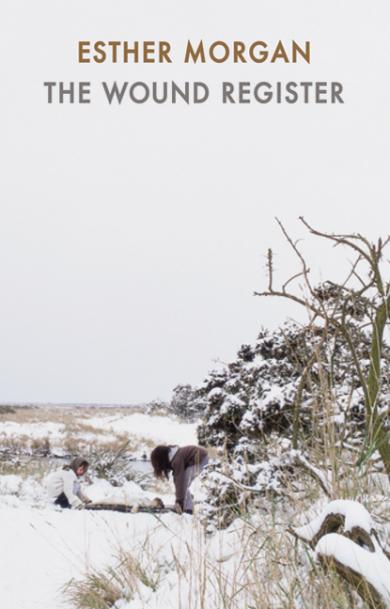
'The Wound Register is a book of compassionate, carefully crafted, skilled poems that reward re-reading. The poems within touch on family relationships with a specific focus that widens to a universal understanding, which makes the poems relatable and engaging.' – Emma Lee, The High Window
‘This year’s runner-up is Esther Morgan for her poetry collection The Wound Register. The title refers to the Casualty Book of the Norfolk Regiment during the First World War. In this luminous, nuanced and emotionally resonant collection, Morgan’s own East Anglian family history is woven into the poems, including her present life as a mother.’ – Andrew Burton, Judge and co-chair, New Angle Prize for Literature (writing in Suffolk magazine)
‘‘The visionary gleam is picked up and amplified by poem after poem in Esther Morgan's superb new collection... Morgan's passion for light is also a yearning for space and air, for an uncluttered and ethereal existence.’ – Jem Poster, Poetry Review
‘Some of these poems are pitch-perfect, combining feeling with sparse language and seeking out exact metaphors to augment their subtle arguments. "This Morning"... is particularly poignant... Along with a handful of the best poems in the book, it confirms Morgan as a talented invoker of the sometimes seismic minutiae of our everyday lives.' – Ben Wilkinson, Guardian
Esther Morgan reads nine poems
Neil Astley filmed Esther Morgan reading a selection of her poems at her home in Suffolk in November 2009. Here she reads one poem, 'The Reason', from her first collection Beyond Calling Distance (2001); then two poems, 'Bone China' and 'At the parrot sanctuary', from The Silence Living in Houses (2005); and six poems from the Eliot-shortlisted Grace (2011): 'Grace', 'Among Women', 'I want to go back to The Angel', 'What Happens While We Are Sleeping', 'After Life' and 'Risen'.
Ireland & EU: Click here to order from Books Upstairs in Dublin
USA: Click here to order from Indiebound or Bookshop.org