


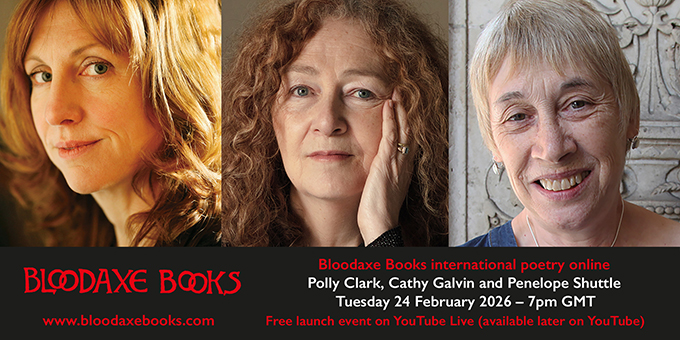
Launch reading by Polly Clark, Cathy Galvin and Penelope Shuttle
We were joined online by Polly Clark, Cathy Galvin and Penelope Shuttle.for the launch of their new titles. All three poets celebrated the publication of their new books by reading live and discussing their work with the host, Bloodaxe editor Neil Astley.
This free Bloodaxe launch event was streamed on YouTube Live and is now available to watch on this YouTube page: https://youtube.com/live/XA38CZZs9yE
To order copies of the poets’ books direct from Bloodaxe, please click on these links.
Polly Clark: Afterlife: New & Selected Poems
https://www.bloodaxebooks.com/ecs/product/afterlife-1386
Cathy Galvin: Ethnology: a love song for Connemara
https://www.bloodaxebooks.com/ecs/product/ethnology-1387
Penelope Shuttle: History of the Child
https://www.bloodaxebooks.com/ecs/product/history-of-the-child-1390
*
Polly Clark: Afterlife: New & Selected Poems
Polly Clark’s poetry inhabits a world that is strange, unsettling, and edged with danger. Her debut, Kiss (2000), journeys inward, exploring the self with an unflinching gaze, before Take Me with You (2005) turns outward to question how we connect – with others, with the wider world, with the unknown. In these collections, her characters, both human and animal, speak in many voices, illuminating the moments when we are most alive – and most alone. Farewell My Lovely (2009) grapples with the price of survival, charting the experience of leaving one's life behind and returning as a stranger. By turns moving and darkly comic, these poems examine the ways we cling to who we were, even as certainty dissolves and the past slips beyond reach.
This retrospective of her poetry opens with a magical new collection – also called Afterlife – in which there are no physical limits, nothing is stable and the world is distilled to its elements. The traumatic experience of rape transforms a girl into a tiger, and a tiger into a girl; a whale embraces both air and water until forced to inhabit only one by jealous fish. The poems grapple with the inexplicable nature of some experience, suggesting that we are most real in that mysterious space between living and dying.
Polly Clark is an award-winning poet and novelist. Her first collection, Kiss, was a Poetry Book Society Recommendation. Her second,Take Me with You, a Poetry Book Society Choice, was shortlisted for the T.S. Eliot Prize. Her third collection Farewell My Lovely was published by Bloodaxe in 2009, followed by her pamphlet, A Handbook for the Afterlife (Templar Poetry, 2015), which was shortlisted in the 2016 Michael Marks Awards. Poems from all these collections and new poems are included in her Afterlife: New & Selected Poems.
*
Cathy Galvin: Ethnology: a love song for Connemara
Ethnology draws on the mystical cry for the dead of Cathy Galvin's Irish-speaking ancestors. Within an epic narrative she reclaims place, people and language, creating a bridge between our own times and a Connemara community on the margins of Europe.
Drawing on classic forms within literary and oral traditions, Ethnology becomes a love song for Connemara, witness to vivid encounters: between the living and the dead and between the poets, folklorists and ethnologists who have written about the West of Ireland for their own agendas.
In her first full-length book of poetry, fragility and strength are finely balanced, focused on the ruins of an island cottage built by her great-grandfather. Here, Cathy Galvin locates humour and joy as well as mourning. The poems give a vivid, original voice to the tradition of keening, of honouring the loss of those we love.
*
Penelope Shuttle: History of the Child
History of the Child is a highly evocative exploration of childhood, memory, and imagination, blending personal and historical perspectives. The book’s themes include parenting, grief, nature, emotional recovery and connections to the past, guided by the idea of childhood as a transformative and rebellious space.
The first of its four sections features poems about Katherine of Aragon, the Vestal Virgins, Stanley Spencer and Wallace Stevens, with a focus on grief, nature, and animals. The second, Book of Lullabies, steps closer to the theme of the child, with poems about memory, inwardness, climate change, sexuality in older age, and the natural world.
The third part, History of the Child, is a journey back to Penelope Shuttle's own childhood, blending personal memories with imagined perspectives to explore psychological crises, emotional recovery, and the traumas of childhood. It introduces an ‘alternative girl child self’, inspired by Persian legends, by her late husband Peter Redgrove’s dream of such a girl (‘my death, and she is my soul’), and by a friend’s fanciful wish. The culminating fourth section is a playful sequence about a little table, inspired by her mother and her childhood. The table symbolises connection to her mother, who lived to be 100 years old, and their shared history.
Penelope Shuttle's History of the Child is guided by themes of memory, imagination, foreboding, magic, history and humour, and seeks to articulate the essence of ‘being’ through fiery language and elemental imagery. She draws inspiration from Donald Winnicott’s concept of the ‘potentive space’ where play, fantasy and reality intersect.
[17 February 2026]