


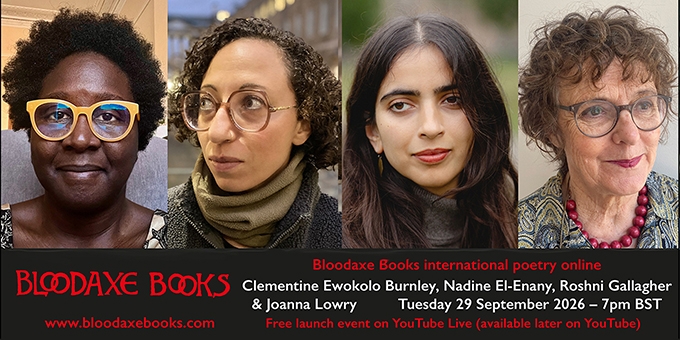
Launch reading with Clementine Ewokolo Burnley, Nadine El-Enany, Roshni Gallagher & Joanna Lowry
Do join Bloodaxe for this launch event for the winners of the James Berry Poetry Prize and the Mslexia Women's Pamphlet Competition. Bloodaxe editor Neil Astley will be joined by the three winners of the James Berry Poetry Prize 2024, Clementine Ewokolo Burnley, Nadine El-Enany and Roshni Gallagher, plus Joanna Lowry, the winner of the Mslexia Women’s Poetry Pamphlet Competition 2025. All four poets will be reading live from their prize-winning new poetry books, followed by a discussion about their work.
This free Bloodaxe launch event will be streamed on YouTube Live on this YouTube page: https://youtube.com/live/obrrYihz56k
If you register to attend on TicketTailor you will receive an event link reminder by email by midday the day before the event.
For those who can't make it live, the reading will be available on YouTube afterwards below or via the same YouTube link: https://youtube.com/live/obrrYihz56k
To order copies of the poets’ books direct from Bloodaxe, please click on these links.
Roshni Gallagher: Even the Trees
https://www.bloodaxebooks.com/ecs/product/even-the-trees-1401
Clementine Ewokolo Burnley: Belling the Leopard
https://www.bloodaxebooks.com/ecs/product/belling-the-leopard-1402
Nadine El-Enany: Pelican Daughter
https://www.bloodaxebooks.com/ecs/product/pelican-daughter-1403
Joanna Lowry: The Man Whose Brain Turned to Glass
https://www.bloodaxebooks.com/ecs/product/the-man-whose-brain-turned-to-glass-1419
*
Roshni Gallagher: Even the Trees
Winner of the James Berry Poetry Prize 2024
Shortlisted for the Jerwood Prize for Best First Collection 2026 (Forward Prizes)
In her debut collection Roshni Gallagher asks what can be seen, named or remembered. From Scotland to Guyana, the poems explore the porous boundary between the past and the present, and how ecological landscapes and landscapes of the mind and body are permanently altered by migration and memory. The elegiac series of poems Kala Pani reflects on the history and legacy of Indian indentured labourers in the Caribbean. Following the experience of women in the moment of rupture as they cross the ocean, these poems hover at the border of what is known and unknown.
Other poems navigate stories from Gallagher’s mixed heritage, from the Windrush generation to the sod houses in Ireland. She explores the tension between historical and personal silence – what can and can’t be spoken about. But stories are retained in the objects around us, from a pair of earrings made from stolen gold to a painting of a waterfall in the childhood home.
The poems look through windows, emerge from darkness, and traverse spaces ‘on the edge of things’ where land gives way to water. Seeing and being seen are often painful, yet there is beauty, healing and connection in what we choose to give our attention to.
*
Clementine Ewokolo Burnley: Belling the Leopard
Winner of the James Berry Poetry Prize 2024
Poetry Book Society Recommendation
In her wide-ranging debut collection, Clementine Ewokolo Burnley asks what remains after once-familiar places and people have gone. The poems criss-cross the Atlantic, beginning in the 1850s. The voices of Caribbean returnees to the west African coast mingle with those of west African recaptives, German missionaries, and kidnappers. They witness the changes in family life through the generations as villagers or townsfolk are uprooted or stay put or uproot themselves, defying expectations by leaving or returning.
Her poems address the past only to illuminate what people can become to each other in the present, whether in Africa or Europe. In one sequence a group of university students from far-flung parts discover the freedoms of student halls in Glasgow. In sequences set in the Hebrides old friends recognise a late-blooming love after decades apart. In other poems, a woman consults her scars. Each sight, sound or smell has its threat value in Germany, and children of mixed heritage switch between languages in Italy. Weary of searching outward, women drop anchor in themselves. A couple find grounding in the non-human world that surrounds them. Going back in search of belonging proves futile only because connection was there all along.
*
Nadine El-Enany: Pelican Daughter
Winner of the James Berry Poetry Prize 2024
The poems of Nadine El-Enany’s debut collection Pelican Daughter are imbued with tenderness and fuelled by a hunger for justice, connection and a more empathic world. With stunning lyricism she fiercely probes the pain of being powerless in the face of global catastrophes – genocide, climate crisis – without tilting into despair. These poems do not divide the personal and political – indeed, boundaries are met with love and defiance, even when they appear immutable.
The voice that permeates is as inviting as it is brave, through the book’s expansive terrain, from the “hopscotch puddles” of childhood to peace marches that do ‘something/to time and space, like we’re here together / but we’re also there’, to a militarised border where people pass ‘prickly pears / over razor wire, sacks of apples and bread’. El-Enany ushers our attention to the vulnerable and the small, the ‘wail of forgotten things’, waking us to what we cannot hear, the ‘woodlice walking / and spiders making silk’. Hers is a poetry of clarity, compassion and enduring love for the world.
*
Joanna Lowry: The Man Whose Brain Turned to Glass
Winner of the Mslexia Women’s Poetry Pamphlet Competition 2025
The long parade of recurring wars and natural disasters forms a shadowy backdrop to Joanna Lowry’s debut pamphlet. Her poems trace the subtle ways in which we attempt to weave our way between these forces of catastrophe through retrieving tiny moments of beauty and contemplation: a few words written on a scrap of paper in a dead poet’s pocket, a clay model of a buddha on a desert floor, a miniature portrait, a cave painting, a shiny fragment of black twisted glass. Each of these objects represents an encounter with a lived moment that is precious, and that is at the centre of a story which is deeply felt and very human, the kind of story that sits outside the larger tide of history, one that helps us to believe we might be saved by art.
[06 August 2026]