


J.H. Prynne (1936-2026)
We are immensely saddened by news of the death of the poet J.H. Prynne, aged 89, who died on 22 April 2026 at Addenbrookes Hospital in Cambridge where he had been receiving palliative care following a recent illness.
J.H. Prynne was Britain's leading late Modernist poet. His austere yet playful poetry challenges our sense of the world, not by any direct address to the reader but by showing everything in a different light, enacting slips and changes of meaning through shifting language. Not since the late work of Ezra Pound and the Maximus series of Charles Olson have the possibilities of poetry been so fundamentally questioned and extended as they were in the life work of J.H. Prynne. When his Poems was published by Bloodaxe in 1999, it was immediately acclaimed as a landmark in modern poetry.
Poems (1999) superseded an earlier retrospective, Poems (Agnes 2, 1982) which collected all the work he'd wanted to keep in print up to that point, beginning with Kitchen Poems (1968). Four further collections were added to the second edition of Poems in 2005, followed by a further seven along with a group of uncollected poems to the third edition of Poems (2015).
The decade following Poems (2015) was the most productive period of Prynne's life, with over thirty limited editions published between 2017 and 2023. To have added these to a fourth edition of Poems would have doubled the size of that volume. His Poems 2016–2024 was therefore a separate, supplementary edition of his later work, including, except for minor corrections, the unchanged contents of 34 texts, from Each to Each (2017), written in 2016, to Hadn't Yet Bitten (2023), as well as the corrected 2023 text of At Raucous Purposeful (2022).
His late flowering continued unabated with four further pamphlets published by Face Press: From Obsidian Cobalt (2024), Doric Plumage (2025), Which Scarf Match (2026) and Single Tangle Mine (2026). He was able to see copies of his last two collections at home in Ferry Path, Cambridge, shortly before being moved to hospital.
Prynne published a wide range of critical and academic prose, including works on Saussure, Wordsworth, Shakespeare. His essay on New Songs from a Jade Terrace, an anthology of early Chinese love poetry, was included in the second edition of the book from Penguin in 1982. He also wrote poetry in classical Chinese under the name Pu Ling-en. His 1969 collection The White Stones – central to his poetics – was reissued in 2016 by New York Review Books with an introduction by Peter Gizzi. An annotated, illustrated edition of his 1983 collection The Oval Window, edited by N.H. Reeve and Richard Kerridge, was published by Bloodaxe in 2018.
Prynne's most productive decade also saw the publication of three prose works, Graft and Corruption: Shakespeare's Sonnet 15 (2015/2016), Apophthegms (2017) and Whitman and Truth (2022), along with editions of Prynne's correspondence with Charles Olson (2017) and Douglas Oliver (2022). His two-volume Collected Prose is forthcoming from Oxford University Press (New York). A seminal interview with Jeff Doven and Joshua Kotin, 'J.H. Prynne: The Arts of Poetry No.101', was published in Paris Review, 218 (Fall 2016).
Born in 1936, Jeremy Halvard Prynne grew up in Kent and studied at St Dunstan's College in Catford and Jesus College, Cambridge. He was a Life Fellow of Gonville and Caius College, Cambridge. In 2005 he retired from teaching English Literature as a Lecturer and from his posts as University Reader in English Poetry for the University of Cambridge and Director of Studies in English for Gonville and Caius College; he retired as Librarian of the College in 2006. He is survived by his wife and two daughters.
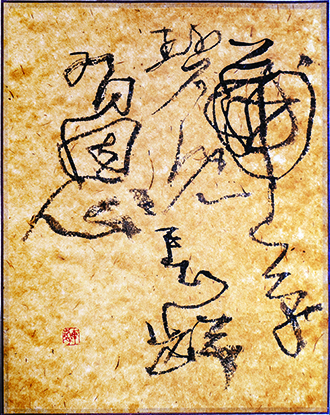
[In keeping with his wish that photographs of the poet should not appear on or with his books, the image from the cover of his Poems 2016-2024 is shown above this piece instead of a photograph of J.H. Prynne. This is a calligraphic rendering of his Chinese name, Pu Ling-en, made by the poet-scholar Che Qian-zi of Suzhou and Beijing in 2000 while at Cambridge University. Prynne believed that a poet's work ought not to be displaced or supervened by notions of authorial personality or aura or presence, which a photograph would inevitably insist on.]
J.H. Prynne, born Bromley, Kent 24 June 1936; died Cambridge, 22 April 2026.
Links to obtuaries and other tributes to J.H. Prynne will be listed here as they are published:
‘Farewell to Britain’s most exciting poet, JH Prynne. How did his genius go unrecognised?’: The Telegraph, 22 April 2026
JH Prynne, erudite and enigmatic poet who became a cult figure to some readers and made others flinch: The Telegraph, online 22 April 2026, in print 23 April 2026
‘Extraordinary and original poet’ JH Prynne dies aged 89: The Guardian, online 23 April 2026
Jeremy Prynne (1936-2026): Gonville & Caius, University of Cambridge, 23 April 2026
The Editors: J.H. Prynne 1936-2026, London Review of Books blog, online 23 April 2026
Gospel Furbelow Dastard: Ian Patterson on J.H. Prynne, London Review of Books blog, online 24 April 2026
In Darkness by Day: Reading J.H. Prynne (1936-2026), Some Flowers Soon, Jeremy Noel-Tod Substack, online 26 April 2026
Will Fleming: The Practical Limits of Daylight: In Memory of J. H. Prynne (1936–2026), The London Magazine, 28 April 2026
JH Prynne, resistance fighter, by Jeremy Noel-Tod, Prospect Magazine, 7 May 2026
J.H. Prynne, Erudite and Elusive British Poet, Dies at 89, New York Times, 8 May 2026
Catherine Brown: Mr Prynne at Caius College Cambridge
J.H. Prynne: Experimental poet, The Times, in print and online 12 May 2026
Marcus Williamson [& Aaron Kent]: J.H. Prynne obituary, The Guardian, online 13 May 2026, in print 10 July 2026
John Clegg on J.H. Prynne: ‘The unexpected should not surprise us: that’s in its nature’, The Poetry Review, Vol 116:2, Summer 2026
Reviews of Poems 2016-2024:
'J.H. Prynne’s Poems 2016-2024 is an essential addition to his Poems (third edition, 2015) as he continues to open new paths into liberating the English lyric and contesting global power structures. The range of innovation is fully evident as is his tireless rereading of texts we might take for granted.' – John Kinsella, Australian Book Review (Books of the Year 2024)
'J H Prynne’s work is difficult, but (unlike the work of many other difficult poets) it is not at all cryptic. There’s no sense of meaning being withheld or obscured; nothing cries out for elucidation. It doesn’t mean, in that sense, at all, and if instead of getting annoyed by it you allow yourself to be swept away, it is buffeting and exhilarating, not at all like any other poetry in the world.' – John Clegg, The Telegraph (Poetry Book of the Month for June 2024)
‘While one might have expected an update of Prynne’s already monumental Poems, the arrival of more than 700 pages of new work is a remarkable turn of events […] Here is a book to keep us busy for a very long time.’ – David Wheatley, The Guardian (Best recent poetry round-up), on Poems 2016–2024
‘What I love about Snooty Tipoffs – and Poems 2016-2024 in general – is that Prynne resists the grave reverie of silence, the late whispers we encounter in Ezra Pound or Samuel Beckett. Instead, the poet blows raspberries, laughs his head off.’ – Luke Roberts, Sidecar (New Left Review)
'Etymological derivations have always mattered immensely to Prynne [...] Prynne’s determined craft of language connects our world of the Now with the world of our Past.' – Ian Brinton, Litter Magazine, on Poems 2016–2024
'Prynne’s late work is full of restless punkish energy, a willingness to reach and extend the reader, and a commitment to plough a furrow so idiosyncratic that it occasionally reads like self-parody. There is a richness in his writing, and it only grows richer with each successive decade, this last one now forming a 752-page treasure trove of its own.' – Andrew Spragg, The Poetry Review
‘Poems 2016-2024 is a massive, vibrant and immersive collation of JH Prynne’s small press publication across this period. Some would call it a late life creative flourish, a glorious coda, but I don’t see it this way. Rather, this is an accumulation of concerns across a lifetime that have both relied on earlier form work and newly “discovered” expressions of genre (in poetry, and generally speaking) that require recasting, resaying, and varying.’ – John Kinsella, Overland Literary Journal
‘Since his 300-page 1982 gathering Poems, which collected all he felt worth preserving at the time, Prynne has delivered three subsequent “bricks”: 1999, 2005, and 2015, the last of which approached 700 pages. Now at eighty-eight years old, he’s added the equally colossal addendum Poems: 2016-2024. It is a magnificent, startling output during what might be the poet’s closing years of writing life. […] The expanse of Prynne’s output during these last eight years is astounding. Poems: 2016-2024 shows an unparalleled poet holding forth at the height of his powers...’ – Patrick James Dunagan, Rain Taxi Review of Books
Reviews of Poems (2015):
'J.H. Prynne’s Poems is a collection, thirty years in the making, in which the language is both astonishing and inevitable. Such a level of intelligence, control and risk is shocking.’ – lain Sinclair, Independent on Sunday (Books of the Year)
'Without doubt the most formidable and accomplished poet in England today, a writer who has single-handedly changed the vocabulary of expression.’ – Peter Ackroyd, The Times
'Prynne presents a body of work of staggering audacity and authority such that the map of contemporary poetry already begins to look a little different.' – Roger Caldwell, The TLS
'This book is one of the most inventive, intelligently experimental collected poems of the century.’ – Adam Phillips, The Observer
‘Poems is a vast slab of a thing, but its luminous and unsettling poems richly repay the attention they demand.’ – David Wheatley, The Guardian [on the third edition of Poems]
‘The place to start with Prynne is The White Stones (1969), one of the great volumes of postwar British verse. Poem after poem of quick, light, original perception re-frames the world with extraordinary freshness.’ – Jeremy Noel-Tod, The Sunday Times [on the third edition of Poems]
'The longer I have stayed with these pieces, the more they have moved and haunted me; the more I have felt altered by having experienced them…Prynne is hard-going, off-putting, and much disliked by many more traditional writers; he is also, when one gets into him, so good that he changes the way you think and feel.’ – Robert Potts, The Guardian (Books of the Year)
‘Prynne is refractory yet astonishingly lucid. First poet of the world for some things.’ – John Kerrigan, The Times Literary Supplement (Books of the Year 2015)
[22 April 2026]