


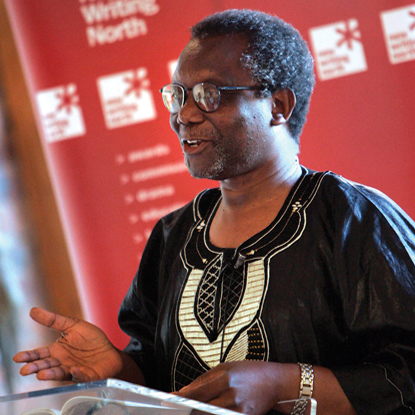
Jack Mapanje (1944-2026)
We were very saddened to hear of the death of Malawian poet Jack Mapanje, aged 82, who came to Britain for medical treatment after his release from prison in Malawi, and stayed. Jack Mapanje was arrested in 1987 and imprisoned without trial or charge on the orders of the dictator Hastings Banda of Malawi. He was head of the Department of English at the University of Malawi when the Malawi authorities arrested him in 1987 after his first book of poems, Of Chameleons and Gods, published six years earlier, had been banned for its alleged criticism of Banda's regime. He was released in 1991 after spending three years, seven months and sixteen days in the notorious Mikuyu Prison in Zomba following an international outcry against his incarceration. He lived in exile in York with his family from 1991.
The themes of Jack Mapanje's poetry range from the search for a sense of dignity and integrity under a repressive regime, incarceration, release from prison, exile and return to Africa, and reconciliation with torturers, to the writer in Africa and the continuing African liberation struggle in a hostile world. While often deadly serious, Mapanje’s poems are lifted by the generosity of spirit and irrepressible humour which helped sustain him through his prison ordeal.
As well as being Malawi's best-known poet, he was a linguist, editor and human rights activitist. Born of Yao and Nyanja parents in Kadango village, Mangochi District, southern Malawi, he went to Kadango Anglican School, Chikawa Catholic Mission School and Zomba Catholic Secondary School. He received a BA degree majoring in English and a Diploma in Education from the University of Malawi. He joined the staff of the English Department at Chancellor College, University of Malawi, in 1972, went to the University of London Institute of Education to read for an MPhil in English and Education (1975) and University College London where he read for a PhD in Linguistics. In 1984 he became head of the English Department at Chancellor College and chair of the Linguistics Association SADC universities (LASU), serving nine universities of Africa south the Sahara, which he helped to found in 1984.
He published six full-length books of poetry: Of Chamelons and Gods (1981) and The Chattering Wagtails of Mikuyu Prison (1993) from Heinemann, followed by Skipping Without Ropes (1998), The Last of the Sweet Bananas: New & Selected Poems (2004), Beasts of Nalunga (2007) and Greetings from Grandpa (2016) from Bloodaxe. His prison memoir And Crocodiles Are Hungry at Night (2011) was published by Ayebia Clarke Publishing. He also co-edited three anthologies, Oral Poetry from Africa (1983), Summer Fires: New Poetry of Africa (1983) and The African Writers’ Handbook (1999); and edited the acclaimed Gathering Seaweed: African Prison Writing (2002). Beasts of Nalunga was shortlisted for the Forward Prize for Best Collection in 2007.
He received the 1988 Rotterdam Poetry International Award for that controversial first book of poems, Of Chameleons and Gods, as well as the US African Literature Association's Fonlon-Nichols Award in 2002 for his contribution to poetry and human rights, the PEN /Barbara Goldsmith Freedom to Write Award (1990), and honorary doctorates from the University of Stirling (1996) and the University of Bedfordshire (2015) for his contribution to poetry and human rights. He received a Cholmondeley Award from the Society of Authors earlier this year, a prize which recognises the achievement and distinction of individual poets. He held academic scholarships at the University of York and Oxford University as well as writers’ residencies at the University of Leiden in the Netherlands, The Open University and University College Cork. For three years he taught African and Caribbean Literature, Literature of Incarceration and Creative Writing in the School of English, University of Leeds. He ran creative writing workshops in schools, colleges, community centres, city libraries as well as prisons throughout the UK. He worked for three years as the Royal Literary Fund Fellow based at Trinity and All Saints College, University of Leeds. After two years as poet-in-residence at the Wordsworth Trust, Dove Cottage, Cumbria – where he wrote his prison memoir – he taught in the School of English at Newcastle University. He was a visiting professor in the faculty of art at York St John University until his retirement.
He was a guest on many BBC radio programmes, including Desert Island Discs in 2004. For a full list of still available recordings, see below.
Jack Mapanje: born Kadango village, Mangochi District, Malawi [then Nyasaland], 25 March 1944; died York, England, 4 November 2026.
* * *
‘Political progress, the poem reminds us, is not by polite invitation: there’s no outstretched hand from authority, no sharing of rope by the prison guards. It has to be conjured up, energised, and repeatedly re-energised, from the mind and body of the activist. Skipping with the imagined rope, Jack Mapanje, as man and poet, makes a creative force of anger that sounds through the world’s many starless nights.’ – Carol Rumens, on ‘Skipping Without Rope’, Guardian Poem of the Week, from The Last of the Sweet Bananas
‘Jack Mapanje’s early poems, written under Banda’s dictatorship, had to be cryptic. Poems written in prison and published after his release were, necessarily, very angry. His latest work is mellower and more mordant in tone. But the conscience, the wit and the craftsmanship which it displays have characterised his work from the beginning. His wholly original, unsubdued voice is still unlike that of any other poet writing in English, from Africa or anywhere.’ – Angus Calder
‘The poems have a raging clarity; the chameleon has become the chattering wagtail…Don’t read this because Mapanje was detained, another human rights victim. Read it because he made poetry out of the experience – sardonic, inventive, lyrical testimonies to a generous and enduring spirit.’ – Landeg White, Stand
‘Given the regime, Mapanje’s satire can seem strangely generous, impressively blending the memory of terror with a sense almost of farce when he considers his captors.’ – Sean O’Brien, Sunday Times.
‘An African talent whose poetry effectively overthrew the dictator’ – David Rubadiri, Vice-Chancellor, University of Malawi
Jack Mapanje: prison poems
Jack Mapanje reads three poems relating to his arrest and incarceration in Mikuyu Prison while recounting his prison experiences, telling how he and his fellow political prisoners were completely cut off from the outside world, denied visitors for long periods, with their loved ones knowing nothing of their fate. He describes the appalling conditions they had to survive while maintaining their sanity, humanity, self-belief and resolve not to be broken, and how much of that was down to solidarity, singing and grim humour. The poems are: ‘Scrubbing the Furious Walls of Mikuyu Prison’, ‘Skipping Without Ropes’ and ‘Your Tears Still Burning at My Handcuffs, 1991’. Pamela Robertson-Pearce filmed him at his home in York in November 2014. This film is from the DVD-anthology In Person: World Poets, filmed & edited by Pamela Robertson-Pearce and Neil Astley (2017).
JACK MAPANJE INTERVIEW CHOSEN FOR PICK OF THE WEEK ON RADIO 4
Pick of the Week, BBC Radio 4, Sunday 17 May 2026, 6.15pm
Jack Mapanje's interview on BBC Radio 4's Soul Music: I Can See Clearly Now was chosen by Viji Alles for his edition of Pick of the Week on 17 May 2026. Details of the original broadcast are below.
1st item.
https://www.bbc.co.uk/programmes/m002wjjz
JACK MAPANJE ON BBC RADIO 4 - A PICK OF THE WEEK CHOICE
Soul Music: I Can See Clearly Now, BBC Radio 4, Saturday 20 April 2024, 10.30am (repeated Monday 22 April 2024, 4.30pm), rebroadcast Friday 15 May 2026, 11.30pm
An interview with poet Jack Mapanje featured in an episode of the BBC Radio 4 series Soul Music in April 2024. He was speaking about how much Johnny Nash’s 1972 hit ‘I Can See Clearly Now’ meant to him when he was in prison in Malawi.
The episode was rebroadcast on 15 May 2026, after which Jack Mapanje's interview was chosen by Viji Alles for BBC Radio 4's Pick of the Week of 17 May 2026. Link below.
‘Poet Jack Mapanje was detained in Malawi’s notorious Mikuyu Prison without charge from 1987 until 1991, under Hastings Banda's regime. He remembers singing the song when other political prisoners were released - "it's a song of hope".’
The programme will remain available on BBC Sounds. Jack features from 12:22.
https://www.bbc.co.uk/programmes/m001yggx
The Jimmy Cliff cover version of ‘I Can See Clearly Now’ was one of the eight tracks which Jack Mapanje chose when he was Sue Lawley’s guest on BBC Radio 4’s Desert Island Discs in 2004.
https://www.bbc.co.uk/programmes/p00936cs
WORLD RADIO PUBLICITY FOR JACK MAPANJE
Outlook, BBC World Service, Monday 25 July 2016, 12.06 pm (repeated multiple times)
Jack Mapanje was interviewed for Arts Daily, a high-profile career interview slot which feeds into the World Service magazine programme Outlook. Interviewees talk about their own lives and how that relates to their art.
Jack spoke about his time in prison in Malawi, about life in exile in the UK, and about how the birth of his grandchildren has given him hope for the future. He read and talked about the title poem from his new collection Greetings from Grandpa.
‘Jack Mapanje has been described as one of the most important African poets writing in English today. He is best known for the poetry inspired by his three and a half years in prison in Malawi in the late 80s, during the dictatorship of Hastings Banda. He was never charged. And after being released, Jack came to live in the UK, and raised a family. His latest collection of poetry, Greetings from Grandpa, is dedicated to his children and grandchildren for "calming the nerves and fears of exile."’
Click here to listen. The interview with Jack Mapanje starts at 13.55
[05 November 2026]