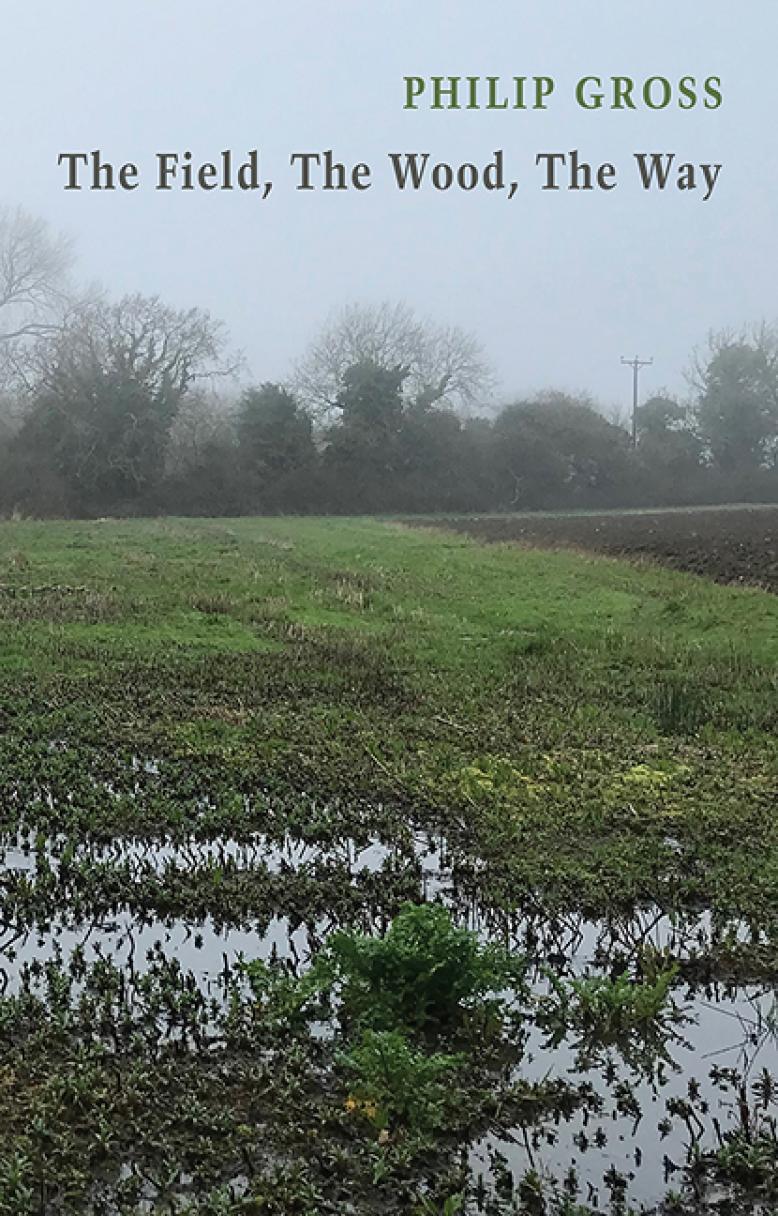
Land in limbo, between town and sea and country, between uses – quarrying, farming, landfill, a stalled housing scheme… This compromised zone is where Philip Gross and his wife Zélie found themselves walking, day after day, in the dead time of the pandemic. With the intelligent eye readers will know from all his writing, Gross deepens this encounter to an enquiry into the toughness of the earth’s lives round us, not always to our liking, seen through the cracks in our human routines. It is also an unsentimental, self-aware account of two people walking together into the hinterland of their old age.
The Field, The Wood, The Way is Philip Gross’s 29th book of poetry, and his 14th from Bloodaxe, following The Thirteenth Angel (2022), which was shortlisted for the T.S. Eliot Prize, and The Shores of Vaikus (2024).
'The Thirteenth Angel , like all of Philip Gross’s work, fuses the physical and the metaphysical, and lights the profoundest subject matter with shafts of playful humour. He is a poet with exceptional gifts of observation, whether it’s a panoramic view of the earth and its inhabitants or ‘the mutterings of quiet circumstance / under the threshold of attention.' – Jean Sprackland, chair of judges, T.S. Eliot Prize 2022
‘Mastery is what you would wish for in a 27th collection and it is what you find in Philip Gross’s The Thirteenth Angel , shortlisted for the T.S. Eliot Prize... His easy, fluent ways with form contrast with his conflicted subject matter. He has a questing eye and now, more than ever, writes to make sense of the world in its inexplicable multiplicity.’ – Kate Kellaway, The Observer (Poetry book of the month)
‘Philip Gross has long since found his groove. His 27th collection, The Thirteenth Angel , muses on shadows and light, reflections and absences…’ – Tristram Fane Saunders, The Daily Telegraph , reviewing the 2022 T.S. Eliot Prize shortlist
‘Philip Gross’s The Thirteenth Angel is a book with its finger firmly on the pulse of the sounds of the contemporary world... Gross uses language which is precise and sharp one moment and then veers into a familiar colloquial style the next, which makes him intensely readable.’ – Mona Arshi, PBS Selector, Poetry Book Society Bulletin , Winter 2022
'An unashamedly conceptual and ambitious book... Gross has written a coercively memorable book about the tumults of our time that makes the art of forgetting as enticing as the art of remembering.' – Kit Fan, The Poetry Review , on The Thirteenth Angel
‘Philip Gross has been publishing poetry for more than forty years and this is an experienced collection in all senses of the word: full of literary expertise but also the pleasures and tolls of maturity…. ‘Angel’ means ‘messenger’, and this sense of poetry’s communicative power – at once modest and metaphysical – is the defining feature of this memorable, strange and often beautiful collection.’ – Victoria Moul, The Friday Poem , on The Thirteenth Angel
‘Paradoxically, The Shores of Vaikus is both a timely and a timeless work. The past is curiously, hauntingly, alive along the shorelines and within the forests of present-day Estonia, the locus of Philip Gross’s latest book. So much is liminal, evanescent […] and the shadow-stories that impel these poems seem all the more chilling at a point in history when old patterns of empire-building are threatening to repeat themselves. […] His tone is modest but his intelligence is fierce. In this his 28th book he’s still seeking to do what the real poets do—to translate the world, and the significance that rests in its silences.’ – Stuart Henson, London Grip
'The Shores of Vaikus is a rich and rewarding collection, thanks largely to the adept deployment of language in ways that provide a welcome aesthetic jolt, but it is also a profound reflection on belonging – not just only to our primary landscape, but to the earth as a whole. [...] It’s a pleasure to read a volume of poetry that is so alert to the multifarious contingencies of history.' – Tom Phillips, The High Window
'Silence, the subject of much of Gross’s previous work, has a watery quality in this book, and his writing about it here is often a transcription into landscape, drawing attention to the lines of water that run across a piece of land seen in vertical profile: sea-levels, the line of the horizon, lines around which small and large and large shifts are continually happening, often very slowly.' – Anna Reckin, Long Poem Magazine , on The Shores of Vaikus
‘The single most consistent theme in Gross is not what we can do with language, but what we can’t: linguistic failures, forgotten words, lost languages, aphasia, profound silence. The Vaikus of his most recent collection, for example, is the name of an island in Estonia, the country his father was from, but also a word for silence; and the collection is about both the landscape of Estonia and what it’s like to speak only a little of the language [….] I am very glad that I first read Philip Gross in 1989, and have had the pleasure and privilege of listening to him all these years.’ – Victoria Moul, Horace & friends , on the poetry of Philip Gross
VIDEO
Philip Gross reads ‘Of Breath (Thirteen Angels’) from The Thirteenth Angel for the T.S. Eliot Prize video readings series.
VIDEO
Philip Gross reads ‘Moon, O’) from The Thirteenth Angel for the T.S. Eliot Prize video readings series.
VIDEO
Philip Gross reads ‘In the Light of the Times’ (‘Springtime in Pandemia’, 4) from The Thirteenth Angel for the T.S. Eliot Prize video readings series.
VIDEO
Philip Gross talks about The Thirteenth Angel for the T.S. Eliot Prize video readings series.
Ireland & EU: Click here
USA: here click here
×