


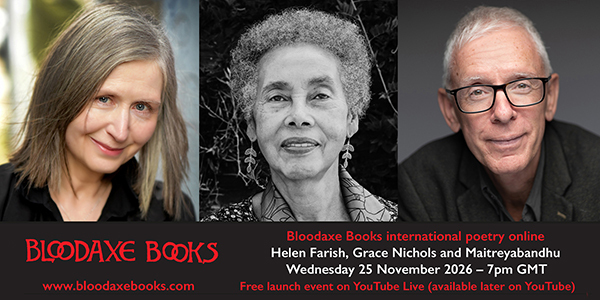
Launch reading with Helen Farish, Maitreyabandhu and Grace Nichols
Do join Bloodaxe for this launch event for our new November titles. Bloodaxe editor Neil Astley will be joined by Helen Farish, Maitreyabandhu and Grace Nichols. All three poets will be reading live from their new poetry books, followed by a discussion about their work.
This free Bloodaxe launch event will be streamed on YouTube Live on this YouTube page: https://youtube.com/live/p1cB6hjTCeY
If you register to attend on TicketTailor you will receive an event link reminder by email by midday the day before the event.
For those who can't make it live, the reading will be available on YouTube afterwards below or via the same YouTube link: https://youtube.com/live/p1cB6hjTCeY
To order copies of the poets’ books direct from Bloodaxe, please click on these links. (Books will be available to order from early November.)
Helen Farish: Monet's Broom
https://www.bloodaxebooks.com/ecs/product/monet-s-broom-1400
Maitreyabandhu: A Commonplace Book
https://www.bloodaxebooks.com/ecs/product/a-commonplace-book-1407
Grace Nichols: The Tracks of My Name
https://www.bloodaxebooks.com/ecs/product/the-tracks-of-my-name-1408
*
Helen Farish: Monet's Broom
Following the artist Claude Monet from his early years in Paris to his death in Giverny in 1926, Helen Farish’s fifth book of poetry, Monet’s Broom, takes the reader from Normandy to the Riviera, from London to Venice as Monet dedicates his life to exploring the ‘artistic ground opening up within himself’. In his desire to forge a new art, Monet demonstrated an unshakeable belief in his own gift, a gift which his first wife, Camille, describes as ‘merciless’: ‘Couldn’t we have had a private moment, / just he and I, for once, not he and I and his art?’ By the time Monet moves to Giverny in 1883, it is Alice, the woman who will become his second wife, whose voice joins Monet’s as together they build a new life.
This wide-ranging and immensely readable sequence draws inspiration from a deep engagement with Monet’s life and art, with the circumstances behind the creation of works which millions now visit but which once hung in deserted galleries. In ‘His War Work’, the artist hears the guns of the First World War as he begins his vast water lily panels, at times expressing his grief (‘the brushed-nickel of dusk, / amethyst tree shadows, a dark which proves / the inside of water can be painted’), at other times finding peace in the natural world: ‘the living water / ruffled just now but not by anything / he has thought’.
Two of Helen Farish’s previous four titles were shortlisted for the T.S. Eliot Prize, including The Penny Dropping (2024).
*
Maitreyabandhu: A Commonplace Book
In a commonplace book, you’d write a recipe, copy a proverb, jot down housekeeping advice, making a precious object out of ordinary things. Maitreyabandhu’s Commonplace Book, his first book-length poem, follows a year from the death of his Buddhist teacher, during which he looks back on scenes from his own life, upbringing, lost loves, and spiritual awakenings. Part epyllion, part diary, it mingles tradition with innovation, comedy with tragedy, traversing the bardo between this life and the next.
Maitreyabandhu is a Buddhist teacher and writer. His first book-length collection, The Crumb Road (2013), was a Poetry Book Society Recommendation, and was followed by Yarn (2015) and After Cézanne (2019). A Commonplace Book includes a QR code linking to an online video of Maitreyabandhu reading the whole book with musician Jasper Llewellyn.
*
Grace Nichols: The Tracks of My Name
Poetry Book Society Choice
The Tracks of My Name sees Grace Nichols embarking on a journey across the English countryside to the small town of Olney in Buckinghamshire.
Olney was where the one-time English slave-trader (later abolitionist) John Newton lived and wrote his famous hymn, Amazing Grace which inspired her Guyanese Methodist parents to name her Grace Olney after both hymn and place.
A narrative sequence that reads as a personal quest, The Tracks of My Name lyrically and imaginatively explores the relationship between memory and history, conscience and greed, a sense of place and love of landscape, through her own distinctive way of viewing the world. Even when confronting some of the more unsavoury aspects of Empire, she makes a space for redemption, continuing the interweave between her Guyanese/Caribbean and British heritages.
[14 October 2026]