


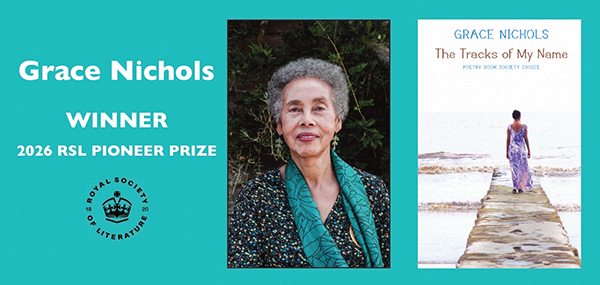
Grace Nichols wins the RSL Pioneer Prize 2026
Grace Nichols has won the 2026 Royal Society of Literature Pioneer Prize, a £10,000 award which celebrates pioneering British women writers over 60 who have been trailblazers in their field. This year’s prize has been awarded to a pioneer in the genre of poetry. The announcement was made by the Royal Society of Literature (RSL) today, 3 November 2026.
As the winner of the 2026 award, Grace Nichols will appear at a special RSL Pioneer Prize celebratory event at the British Library on Monday 1 March 2027.
The 2026 judging panel was chaired by Ruth Borthwick, current Chair of English PEN and formerly Chief Executive and Artistic Director of Arvon, along with poet, academic and editor Sarah Howe and Judith Palmer, Director of the Poetry Society since 2008.
Chair of Judges Ruth Borthwick said:
'Grace Nichols is one of our most important contemporary poets. Ever since I is a Long Memoried Woman opened us up to her imagination forty-three years ago Grace has, like a pioneering plant, colonised new territory in modern Britain, and crafted her own poetic language - an earthy mix of Creole and standard English. Her range is boundless. She can employ wry humour to comment on the political situation just as skilfully as she can write playful rhyme and rap for children. Grace showed the way for generations of poets from the diaspora to make the cultural connections between the Caribbean and Britain. She embodies the spirit of the RSL Pioneer Prize and we are proud to honour her.'
Judge Sarah Howe commented:
'Grace Nichols is a legend, a trailblazer in the truest sense. Her work spans continents and traditions, alive to orality and shapely on the page, light and weighty at once. Her work blends the rhythms and stories of her Caribbean heritage with a unique vision of modern Britain. Her poems for children are no less to be treasured, and her work has helped open up the joy of poetry to generations of young people. She has opened many doors, creating space for other writers through her long career.'
Judge Judith Palmer said:
'What a joy to be able to recognise a poet, who has herself brought joy to so many. Thank you, Grace Nichols for everything you’ve done over your energetic career to inspire readers and writers of all ages. Even when tackling difficult subjects, Grace’s poetry has a warmth and a lightness of touch which buoys you up and sparks kinship. She was probably the first poet who really lifted poetry off the page for me, and over the decades I’ve seen her cast her spell over successive generations; a modest, sure-footed trailblazer who has succeeded in making so many more people feel that poetry is a place where they too might belong.'
On hearing of the award, Grace Nichols said:
'It was a wonderful surprise when Ruth Borthwick, one of the judges of the Pioneer Prize rang to say that I was the recipient of this year’s Prize. The word, Pioneer, is an interesting one and my mind immediately flashed to when, as young students at the University of Guyana (our university education was free) but we had to do a month’s ‘National Service’ before graduation. Dressed in military uniforms we served as ‘Young Pioneers’ in the forested region of Guyana, as part of the Government plan to develop a Hydro-project Scheme in our hinterland. Maybe that’s what we do as poets in the act of writing a poem or book, we’re like pioneers embarking on a new adventure with language in the forest of the imagination, finding a path true to our essential voice and vision, lighting things up from our own perspective. I am honoured and delighted to have the ‘RSL Pioneer Prize’ bestowed on me and grateful to poetry for all that it’s given me, as well as to the judges and my parents who made books a part of our lives.’
Born in Guyana, Grace Nichols has lived in Britain since 1977. Her poetry for adults has been published by Bloodaxe Books since 2009. Her new poetry book The Tracks of My Name, a narrative sequence exploring her Guyanese/Caribbean and British heritages, is published by Bloodaxe Books in November 2026. It is the Poetry Book Society's Choice for Winter 2026.
Grace Nichols has published four previous books with Bloodaxe: Picasso, I Want My Face Back (2009), I Have Crossed an Ocean: Selected Poems (2010), The Insomnia Poems (2017) and Passport to Here and There (2020). Her poetry is studied in UK schools as part of the GCSE National Curriculum. She was made a Vice-President of the Royal Society of Literature in 2020 and was awarded The Queen’s Gold Medal for Poetry for 2021.
The Pioneer Prize was founded in 2025 by RSL President Emerita Bernardine Evaristo, who generously donated the cash prize of £100,000 from her Women's Prize Outstanding Contribution Award to fund this new prize. This special one-off honour marked the 30th anniversary of the Women’s Prize for Fiction and celebrated Bernardine’s own body of work, her transformative impact on literature and her unwavering dedication to uplifting under-represented voices across the cultural landscape. An expanded edition of Bernardine Evaristo’s debut novel-in-verse Lara was published by Bloodaxe Books in 2009, a decade before she won the Booker Prize for her novel Girl, Woman, Other.
On establishing the Pioneer Prize, Evaristo said:
‘It felt right that I should share this substantial and unexpected windfall with other older women writers as a way to acknowledge their pioneer spirits and achievements. It's very easy to forget the feminist struggles of the past and the intrepid women who paved the way for successive generations, and it's important to celebrate our trailblazers while they are still around to enjoy it: to remember them, to thank them, to honour them.’
The RSL Pioneer Prize, and before it the Women’s Prize Outstanding Contribution Award, were both supported by Bukhman Philanthropies, who elected to match Evaristo’s donation of £100,000 to support the legacy of the prize and its recipients. The winner of the inaugural RSL Pioneer Prize in 2025 was the poet, playwright, novelist, activist and non-fiction writer Maureen Duffy. The winner of the RSL Pioneer Prize receives £10,000.
~~~~~
For digital or print review copies of The Tracks of My Name, or any of Grace Nichols' previous Bloodaxe titles, please e-mail Christine Macgregor at publicity@bloodaxebooks.com.
~~~~~
Grace Nichols will be reading in person at the Poetry Book Society Winter Showcase at the Newcastle Centre for the Literary Arts on 11 November 2026. She will also be reading at the Coronet Theatre in London on 19 November, and at the RSL Pioneer Prize celebratory event at the British Library on 1 March 2027. For full details, see here.
A film extract of Grace Nichols' reading at the PBS Winter Showcase event in Newcastle on 11 November will be played as part of Bloodaxe's joint online launch on 25 November 2026.
~~~~~
Grace Nichols' poem ‘For the Life of This Planet’ from her 2010 retrospective I Have Crossed an Ocean: Selected Poems is featured on the Autumn 2026 set of Poems on the Underground posters. See the poster here.
Hear poet Marjorie Lotfi read the poem: https://poemsontheunderground.org/this-months-poems
~~~~~
Born in Guyana, Grace Nichols has lived in Britain since 1977. Her first collection, I is a Long-Memoried Woman (1983), won the Commonwealth Poetry Prize. Most of that book is included in her later retrospective, I Have Crossed an Ocean: Selected Poems (2010). Four subsequent poetry collections were published by Virago: The Fat Black Woman’s Poems (1984), Lazy Thoughts of a Lazy Woman (1989), Sunris (1996), winner of the Guyana Prize, and Startling the Flying Fish (2006), poems which tell the story of the Caribbean. Her later books from Bloodaxe are Picasso, I Want My Face Back (2009); I Have Crossed an Ocean: Selected Poems (2010); The Insomnia Poems (2017); Passport to Here and There (2020), a Poetry Book Society Special Commendation; and The Tracks of My Name (2026), a Poetry Book Society Choice. She has also published several poetry books for younger readers, including Come on into My Tropical Garden (1988), Give Yourself a Hug (1994), Everybody Got a Gift (2005) and Cosmic Disco (2013). She was made a Vice-President of the Royal Society of Literature in 2020. Grace Nichols received The Queen's Gold Medal for Poetry for 2021 from Her Majesty Queen Elizabeth at Windsor Castle in 2022. She lives in Sussex with the poet John Agard.
~~~~~
'Over the past four decades, Grace has been an original, pioneering voice in the British poetry scene. A noted reader and ‘performer’ of her work, she has embraced the tones of her adopted country and yet maintained the cadences of her native tongue. Her poems are alive with characters from the folklore and fables of her Caribbean homeland, and echo with the rhymes and rhythms of her family and ancestors. Song-like or prayer-like on occasion, they exhibit an honesty of feeling and a generosity of spirit. They are also passionate and sensuous at times, being daring in their choice of subject and openhearted in their outlook. Above all, Grace Nichols has been a beacon for black women poets in this country, staying true to her linguistic coordinates and poetic sensibilities, and offering a means of expression that has offered inspiration and encouragement to many. She is a moving elegist, and a poet of conciliation and constructive dialogue between cultures, but also a voice of questioning dissent when the occasion demands.' – Simon Armitage, Poet Laureate, on behalf of The Queen's Gold Medal for Poetry Committee 2021
In March 2022 Grace Nichols was presented with The Queen's Gold Medal for Poetry for 2021 by Her Majesty Queen Elizabeth II. You can hear her speaking about her response to this honour, and reading poems from Passport to Here and There, in a special edition of BBC Radio 3's The Verb recorded in The Queen's Library at Windsor Castle in May 2022.
Listen here (Grace features from 21:06)
~~~~~
Praise for Grace Nichols' poetry:
‘Not only rich music, an easy lyricism, but also grit, and earthy honesty, a willingness to be vulnerable and clean.’ – Gwendolyn Brooks
‘She combines written language with musical language, and with song, and literal song in some cases. Also the way Grace has managed to fuse together the language and the syntax of her native Guyana with British poetical language as well to produce something both unique and really important as a model for other writers who want to follow in that same direction.’ – Simon Armitage, Poet Laureate, The Verb (at the Queen’s Library, Windsor Castle)
'Grace Nichols gently, imaginatively, carefully challenges contemporary Britain… and has gone on to continually articulate women’s voices, exile, ancestors, the echoes that resonate from a place of birth and renew her poetic treatment of them. What she showed me in The Fat Black Woman’s Poems and continues to show me as her work moves through geography, history, legend, is the holistic nature of writing – she opened up our options.' – Jackie Wills, On Poetry
‘Grace Nichols has wit, acidity, tenderness, any number of gifts at her disposal.’ – Jeanette Winterson
‘From her first collection in 1983, I Is a Long Memoried Woman, she has been a strong presence in the linguistic interweave between the Caribbean and the UK. Her poetry and prose move easily between the poised world of Western culture, Old World history and myth, and the gritty rhythms of the Caribbean everyday… There is wit, irony and passion…real poise.’ – Michelene Wandor, Poetry Review
‘Grace Nichols came to Britain from Guyana at the age of 27 and she has carried the warmth of her Caribbean sensibility through many a cold English winter. Her poems celebrate sensuality and generosity and attack petty mean-spiritedness… Deeply Caribbean in sensibility, she writes sensitively of other traditions, especially Africa and India.’ – Peter Forbes, Contemporary Writers
'Nichols’s ninth collection is split, like her identity, between the Guyana where she grew up, and the England which she has made her home. She uses Creole and the imagery of ghosts to conjure up her coming of age in South America... she often draws on the natural world for her metaphors, and her style is characterised by alliteration and assonance. One section of unrhymed 14-line poems, illustrated with black-and-white photographs by Compton Davis, she calls “Back-homing (Georgetown Snapshot Sonnets).” She then brings her adopted country to life with poems on everything from tea and the Thames to the London Underground and the Grenfell Tower fire. A final set of elegies (including one to Derek Walcott) feels like a fittingly sombre close.' – Rebecca Foster, Shiny New Books (Poetry Highlights of 2020) on Passport to Here and There
‘Another collection that sifts lived experience for personal truths is Grace Nichols’s Passport to Here and There. Nichols is known for her social commentary, a key voice in the literary interchange between the Caribbean and the UK. This new book contains poems that capture a conflicted view of an adopted England… These warmly nostalgic but undeceived works are, by her own reckoning, attempts to “preserve experiences, people and places in an effort to save them from time’s erasure”.’ – Ben Wilkinson, The Guardian (Poetry Books of the Month)
‘…this is not just a personal journey, it is also one that is bound up with politics and history, a concern for the environment and recent events that have dominated the media…. There is much to admire in this collection which charts so well the two different cultures that have helped to shape Nichols and her writing over the years. Fully recommended.’ – Neil Leadbeater, Write Out Loud, on Passport to Here and There
'Both Parker and Nichols dwell on questions of home and belonging. How does a faraway country of origin affect everyday life when it is a distant memory or an unseen land of family legend? The poets recognise the challenge of valuing two countries equally, and boldly expose the way in which devotion to a narrow vision of heritage can lead to exclusionary policies. Troubled by recent politics and ongoing racial injustice, they skirt despair by turning once again to poetry, which, as Nichols writes in her homage to Walcott, can be a way ‘to console ourselves/against the tyranny of Time and Death.' – Rebecca L. Foster, Wasafiri, on Passport to Here and There and Louisa Adjoa Parker's How to Wear a Skin (Indigo Dreams)
‘Unquestionably one of our most important living poets, Grace Nichols returns with her ninth collection of poems about a childhood in Guyana and move to Britain. With wit and warmth, Nichols delves into the what is lost and gained by being between places.’ – Katie Goh, i-D (Books to read in 2020), on Passport to Here and There
‘To write beyond middle age with anything like the transmuting fire of youth requires – so the adage says – much wilful forgetting in order to remember at a deeper level of meaning for readers. Grace Nichols in this new collection of her work succeeds in revisiting her Guyana past to make poems of lightness and diction and depth of feeling. The Demerara region takes on heraldic relevance and the people in it, principally her parents, along with flora and fauna, populate a landscape of metaphoric and allegorical longing. Her simple diction belies a complex emotional intellect and a feel for the balance of a line, its weightlessness in collusion with a depth of feeling. This may be Grace Nichols at her best, in poems that chime with bright imagery and lasting phrasing worthy of chanting to undermine and contradict, if not bringing down the authoritarian edifices of our dangerous times.’ – Fred D'Aguiar, on Passport to Here and There
Grace Nichols reads at the 2022 Newcastle Poetry Festival
Grace read ‘A Brief Odyssey’ from The Insomnia Poems, published in 2017. She then read several poems from her 2010 I Have Crossed an Ocean: Selected Poems - ‘Old Canecutter at Airport’, ‘Dust’, ‘Grease’, and ‘With Apologies to Hamlet’. Grace finished her reading with two poems from her 2020 collection Passport to Here and There: ‘Battle’ and ‘Atlantic’. Filmed by Peter Hebden. Special thanks to Newcastle Centre for the Literary Arts.
Forthcoming Wednesday 25 November 2026, 7pm GMT (YouTube)
Bloodaxe online launch reading with Helen Farish, Maitreyabandhu and Grace Nichols
Do join Bloodaxe for this launch event for our November 2026 titles. Bloodaxe editor Neil Astley will be joined by Helen Farish and Maitreyabandhu, who will be reading live from their new poetry books, followed by a discussion about their work with each other and with Neil Astley. A film extract of Grace Nichols' reading at the Poetry Book Society's Winter Showcase event held at Newcastle Centre for the Literary Arts on 11 November 2026 will be played as part of Bloodaxe's online launch.
This free Bloodaxe launch event will be streamed on YouTube Live on this YouTube page: https://www.youtube.com/watch?v=qY_dtbM6Ldw
[03 November 2026]